
Crenshaw County Court Records After a Jail Arrest
Court records after a jail arrest sit beside the arrest record, which is the law-enforcement and booking-side record of an arrest. It may show that a person was taken into custody, booked at the detention facility, processed on a warrant, or released or transferred. That record is not the same as the formal criminal case. After booking, the prosecutor and court process determine which charges are filed and tracked by the clerk.
Use jail inmate records for custody and booking questions and jail roster mugshots for booking-photo access. Use court records for charges after arrest, court dates, case status, dispositions, and case-action summaries. A booking charge can be amended, reduced, dismissed, or replaced by a different filed charge.
Crenshaw County Court Record Office
The official Crenshaw County - 2nd Judicial Circuit site lists the courthouse and Circuit Clerk contact. The courthouse address is 29 S. Glenwood Ave., Suite 206, P.O. Box 167, Luverne, AL 36049. The Circuit Clerk phone is (334) 335-6575, and the court site lists hours as 8:30 a.m.-4:30 p.m., Monday-Friday.
The court site states that the Circuit Clerk cannot give legal advice. Ask for records, filing process, case numbers, docket information, or copy procedure. Do not ask clerk staff whether a defendant should plead, post bond, seek expungement, or handle a charge in a certain way.
The Crenshaw County court page shows the local clerk contact and courthouse hours used for court records after a jail arrest.
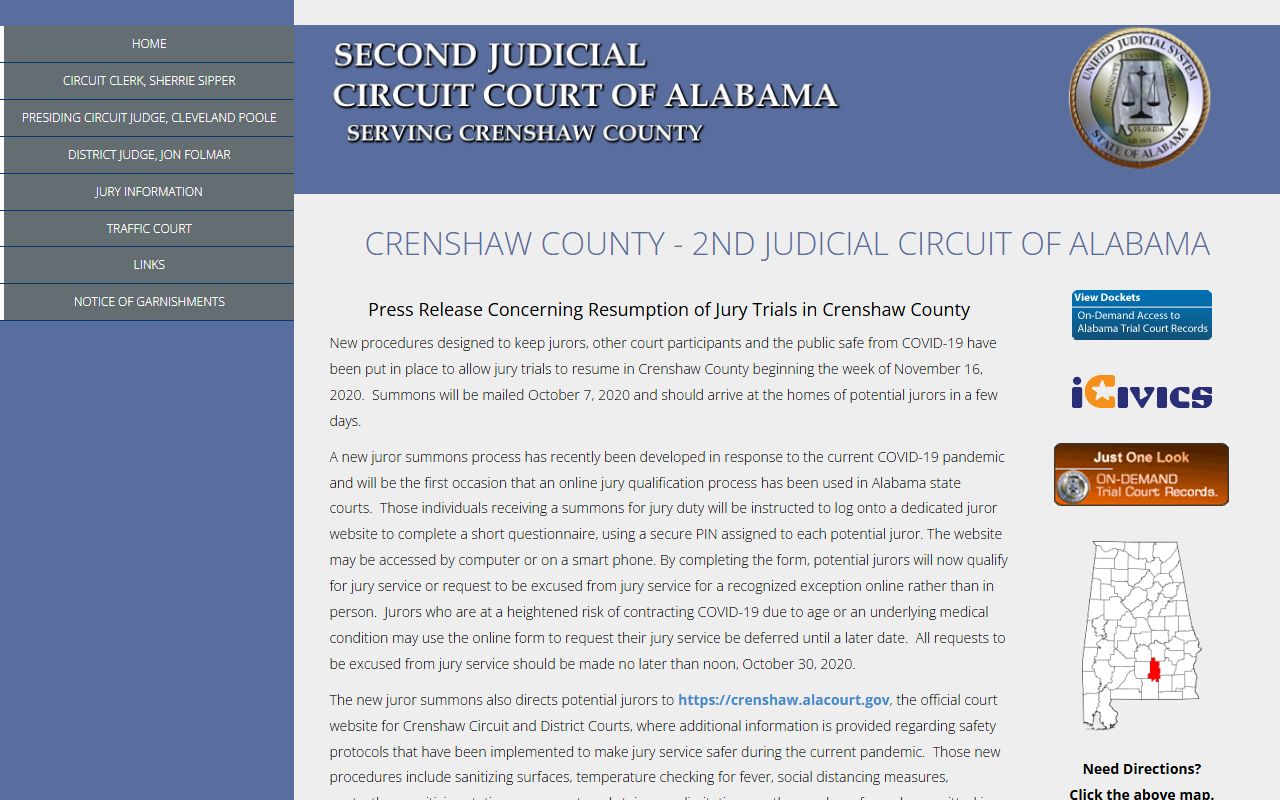
That court contact is separate from the jail contact used for current custody.
How to Find Crenshaw County Court Records After an Arrest
Alacourt ACCESS is the official paid portal documented in the research file for Alabama trial-court records. It advertises criminal, civil, small claims, state traffic, domestic relations, and child-support records. For an arrest-to-court search, use it after a case exists, not while the person is still being processed at jail.
- Gather the defendant's full name, date of birth if known, arrest date, and any case or warrant number.
- Search by name or case number through Alacourt ACCESS, or contact the Circuit Clerk if the case is hard to locate.
- Open the case detail to review filed charges, court action, case status, setting dates, party information, financial history, and case action summary.
- Compare filed charges with the booking information because the court charge may not match the arrest charge.
| Alacourt Field or Product | Type | Notes |
|---|---|---|
| Name Search | Paid search route | $9.99; one case detail included, with additional case detail charged separately. |
| Case Number Search | Paid search route | $9.99; best when the exact case number is known. |
| Document Images | Paid document access | $5.00 first 20 pages, then $0.50 per page. |
| Case Monitoring | Paid monitoring option | District case $19.99; Circuit case $29.99. |
Booking to Crenshaw County Court
The arrest-to-court pathway often moves through several steps. An officer or warrant leads to arrest. Jail staff process the person through booking. Early court contact may address rights, custody, and bond. The District Attorney for Alabama's 2nd Judicial Circuit reviews the matter and decides what to file or present. The clerk then creates or maintains the court record once the case is filed.
The sheriff external-links page lists the District Attorney's Office phone as (334) 382-7444. Research identifies Charlotte M. Tesmer as the current district attorney through regional/local public sources, but no dedicated official DA website was located. Use the DA phone for prosecution-office routing and the clerk for court records.
The court record may not appear the same day as the arrest. The jail booking charge can be based on warrant language or officer paperwork, while the filed court charge reflects prosecutor review and clerk processing. A person searching minutes or hours after an arrest may need the jail first, then the clerk or Alacourt once the case number exists.
Process flow: Arrest › Booking › First Appearance or Bond Review › Prosecutor Screening › Complaint, Information, or Indictment › Court Case Record.
Crenshaw County Charging Documents
Different charging documents can start or shape a criminal case. The correct document depends on the charge, case stage, and Alabama procedure. The table below defines the terms without claiming that every Crenshaw County arrest follows the same path.
| Document | Plain Meaning | Why It Matters |
|---|---|---|
| Complaint | A sworn allegation or charging paper that can start a criminal case. | Often appears early and may differ from later prosecutor action. |
| Information | A prosecutor-filed charging document used in some felony or misdemeanor paths. | Shows what the prosecution has chosen to file. |
| Indictment | A grand-jury charging document. | Can replace or refine earlier arrest or complaint language. |
Crenshaw County Charge Status Terms
Charge status can change throughout a case. A booking charge is not proof of guilt and may not be the final charge. Prosecutors can amend, reduce, add, or dismiss charges, and a judge may enter orders that affect bond, custody, or case status.
| Status | Meaning |
|---|---|
| Pending | The charge is open and not resolved. |
| Amended | The charge was changed by prosecutor or court action. |
| Reduced | The charge was lowered to a lesser offense. |
| Dismissed | The charge was ended by court or prosecutor action. |
| Nolle prosequi or nol-pros | The prosecutor declines to proceed on that charge. |
| Conviction | A final finding or plea of guilt, not the same as an arrest. |
Bond After a Crenshaw County Arrest
Crenshaw County did not publish a jail bond policy, payment method list, or bond-posting hours in the official material located. Call the jail to ask whether bond has been set, whether a hold prevents release, and where bond must be posted. For court-set bond or case changes, contact the Circuit Clerk or use Alacourt once the case is filed.
| Bond or Hold Term | Meaning |
|---|---|
| Cash bond | Money paid directly as security for court appearance. |
| Surety bond | A licensed bonding company posts bond and charges a fee. |
| Property bond | Qualifying property secures the release, subject to court approval. |
| Personal recognizance | Release based on a written promise to appear, sometimes called PR bond. |
| No-bond hold | Release is blocked until court action or another condition changes. |
Note: A single detainer, warrant condition, probation hold, federal hold, or ICE issue can block release even when another charge has a bond amount.
Crenshaw County Warrants and Arrest Records
No official Crenshaw County sheriff active-warrant database, warrant list, or most-wanted database was located on the sheriff site. A warrant can still lead to a jail booking, and a court record may later show warrant-related case actions. Use the sheriff general number for routing, the jail to ask whether a person was booked on a warrant, and the Circuit Clerk or Alacourt for case-action information when public.
Luverne Police and Brantley Police may matter when a municipal or traffic issue led to arrest. The sheriff external-links page lists Luverne Police at 334-335-2406 and Brantley Police at 334-527-3244, but it does not show city jail rosters or warrant databases.
A bench warrant often relates to a missed court date or violation of a court order. An arrest warrant usually begins with probable cause or a sworn allegation. A fugitive warrant or agency hold can involve another jurisdiction. Those labels affect bond and release, so the useful question is not just whether a warrant exists, but whether any hold prevents release from the Crenshaw County Detention Facility.
Charges vs Convictions
An arrest, a booking charge, and a conviction are different legal events. A person can be arrested and never convicted. A charge can be changed or dismissed. A conviction requires a plea or finding of guilt and becomes a different kind of record from the arrest itself.
| Charge | Conviction | |
|---|---|---|
| Stage | Accusation or filed offense. | Final guilty plea or finding. |
| Source | Booking record or court filing. | Court disposition and judgment. |
| Can Change? | Yes, it may be amended, reduced, or dismissed. | Changes require court action, appeal, set-aside, or other legal process. |
Restricted Court Records After an Arrest in Crenshaw County
Alabama expungement is handled through the courts, not by ALEA alone. The ALEA expungement page explains that courts grant expungements and points users to AOC petition materials. Alabama Code § 15-27-1 covers certain misdemeanor, violation, traffic, and municipal ordinance records, while § 15-27-2 covers certain felony records.
| Sealed | Expunged | |
|---|---|---|
| Public access | Public view may be restricted. | Eligible records may be removed from public access by court order. |
| Who decides | Court order or applicable law. | Alabama court process under Chapter 15-27. |
| Practical step | Ask the clerk about record status. | Use court/AOC petition materials or legal counsel. |
ALEA Criminal History Records
An ALEA criminal-history request is different from a Crenshaw County court lookup or jail booking request. The ALEA Alabama Background Check page says a request requires fingerprints, photo ID, an application, and a $25 money order or cashier's check, with extra copies listed at $5. That route is for releasable criminal-history information, not for a free jail roster.
Alabama's criminal justice information system statutes begin at Alabama Code § 41-9-590. The public-records baseline for inspection and copying appears in § 36-12-40, with copy-fee authority in § 36-12-41. Law-enforcement investigative material has limits under § 12-21-3.1.
That separation protects the meaning of each record. A jail booking record answers what happened at intake. A court record answers what was filed and how the case moved. A criminal-history response is a state-level record-release process governed by criminal justice information rules. Mixing those sources can make an arrest look like a conviction or make a custody search look like a background check.